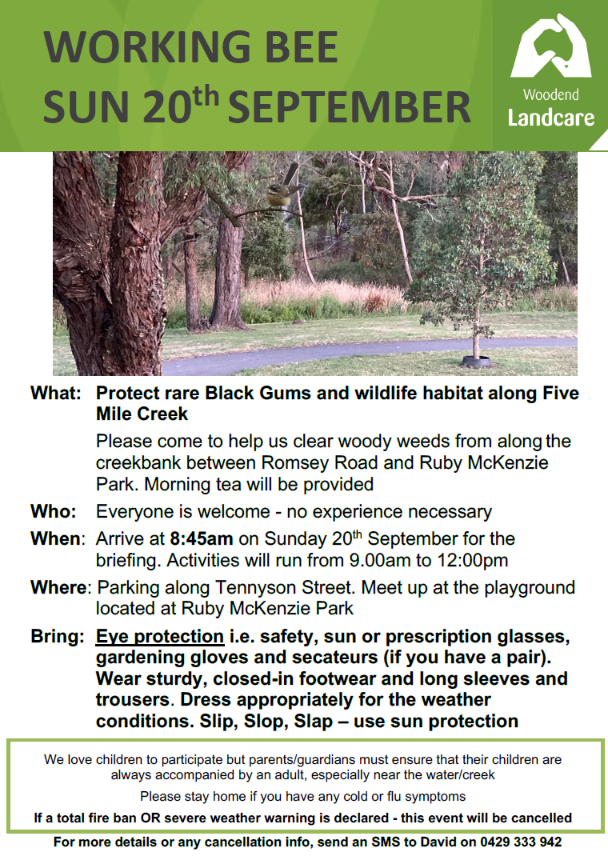
Help Woodend Landcare maintain the native vegetation along the banks of Five Mile Creek. On Sunday 8 November, we will be clearing woody weeds and ivy between Jo’s Bridge and Wood Street. Morning tea will be provided. New volunteers are always very welcome!
Join Woodend Landcare to celebrate our achievements from the past year and look ahead to future plans. Our special guest speaker, fauna ecologist John Harris, has been studying wildlife along Five Mile Creek, using high-tech equipment to record birds, marsupials, bats, frogs, and more. Come find out what he has discovered.
Woodend Landcare Annual General Meeting Where: Woodend Neighbourhood House When: 10am – 12pm, Sunday 25 October
Our AGM is open to Landcare members and the public. Registration is not required – just turn up! Morning tea refreshments will be provided.
Keen to lend an extra hand to Woodend Landcare?
Consider joining the Woodend Landcare Committee. We are looking for a Meetings Secretary to help with the agenda and minutes for our monthly meetings and a Communications Secretary to help coordinate our publicity and marketing. We would also welcome a new General Committee Member. If this sounds like something you could help with, please contact Nicole Middleton at woodendlandcare@gmail.com or call 0418 233 366 before Sunday 18 October.
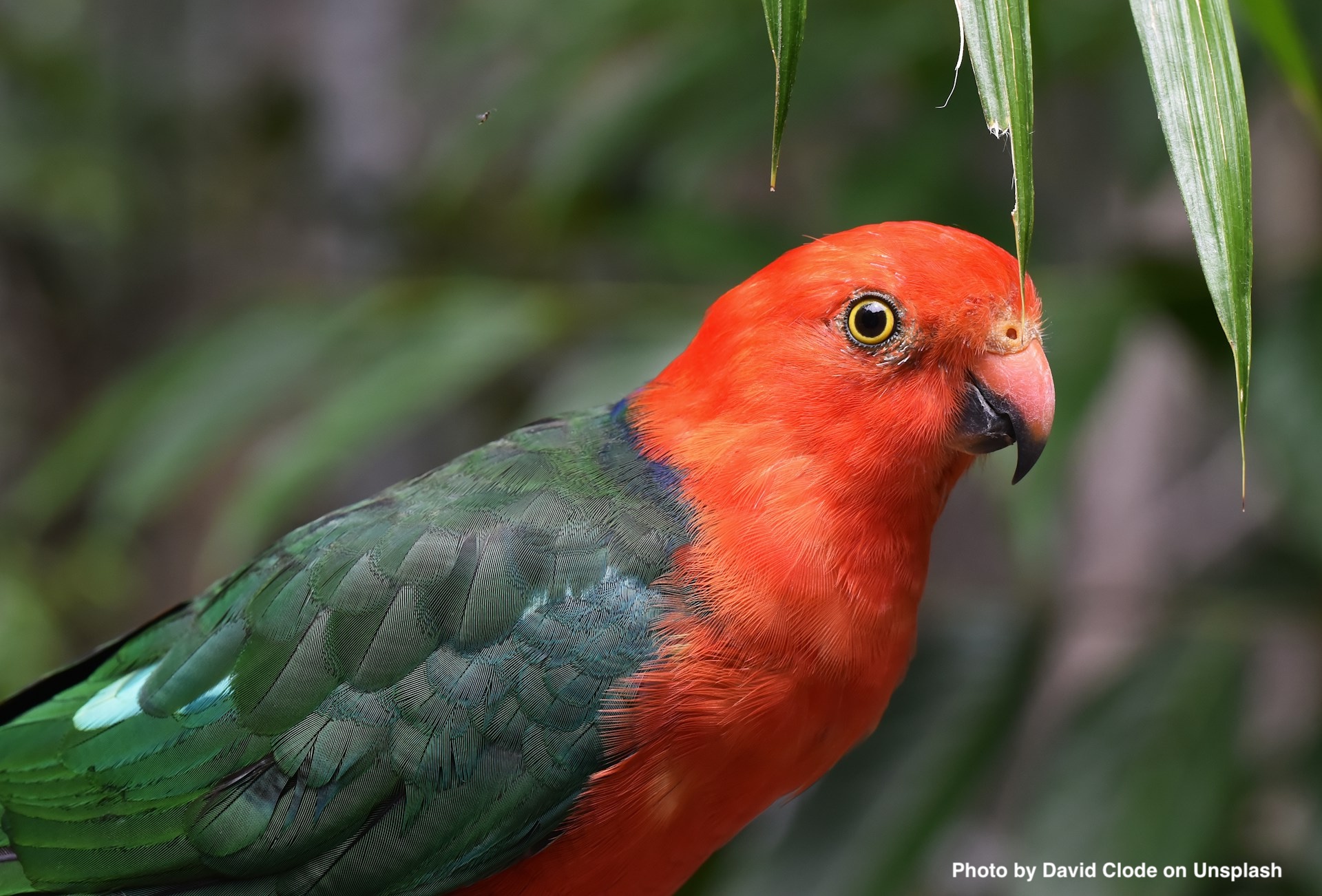
Woodend Landcare invites you to join us for Brekky with the Birds on the 10 October 2026. Meeting at the Woodend Children’s Park at 6.45am, we will take a stroll along Five Mile Creek with ecologist, John Harris. You’ll learn how to survey and identify our local feathered friends. A light breakfast will be provided. Places are limited so registration is essential: Click here to register.
This month our working bee on Sunday 20 September will be focusing clearing woody weeds along the Five Mile Creek between Romsey Road and Ruby McKenzie Park. Arrive at 8.45am for a briefing at the playground in Ruby McKenzie Park on Tennyson St. You bring eye protection, gloves and secateurs (if you have some), we’ll provide a tasty morning tea! Hope to see you there!
Where are the “Envirofund Paddocks” and why do we use that name?
Back in 2003 it was decided to make a major effort to eradicate many weedy trees and woody weeds along Five Mile Creek and return the area to something resembling its pre-European state by planting thousands of local indigenous plants. We called the first stage of this project the “Black Gum Rescue”. The target area was on public land along both sides of the creek from Romsey Road to just east of the yet to be created Children’s Playground.
We obtained funding for the initial stage from the Bundaberg Rum Bush Fund and then the later stages were funded by the federal government’s “Envirofund”. Altogether, we received about $72,000, mostly from Envirofund, which in those days was a lot! The money enabled us, with help from MRSC, contractors and lots of volunteers to clear most of the major weeds and plant about 14,000 plants.
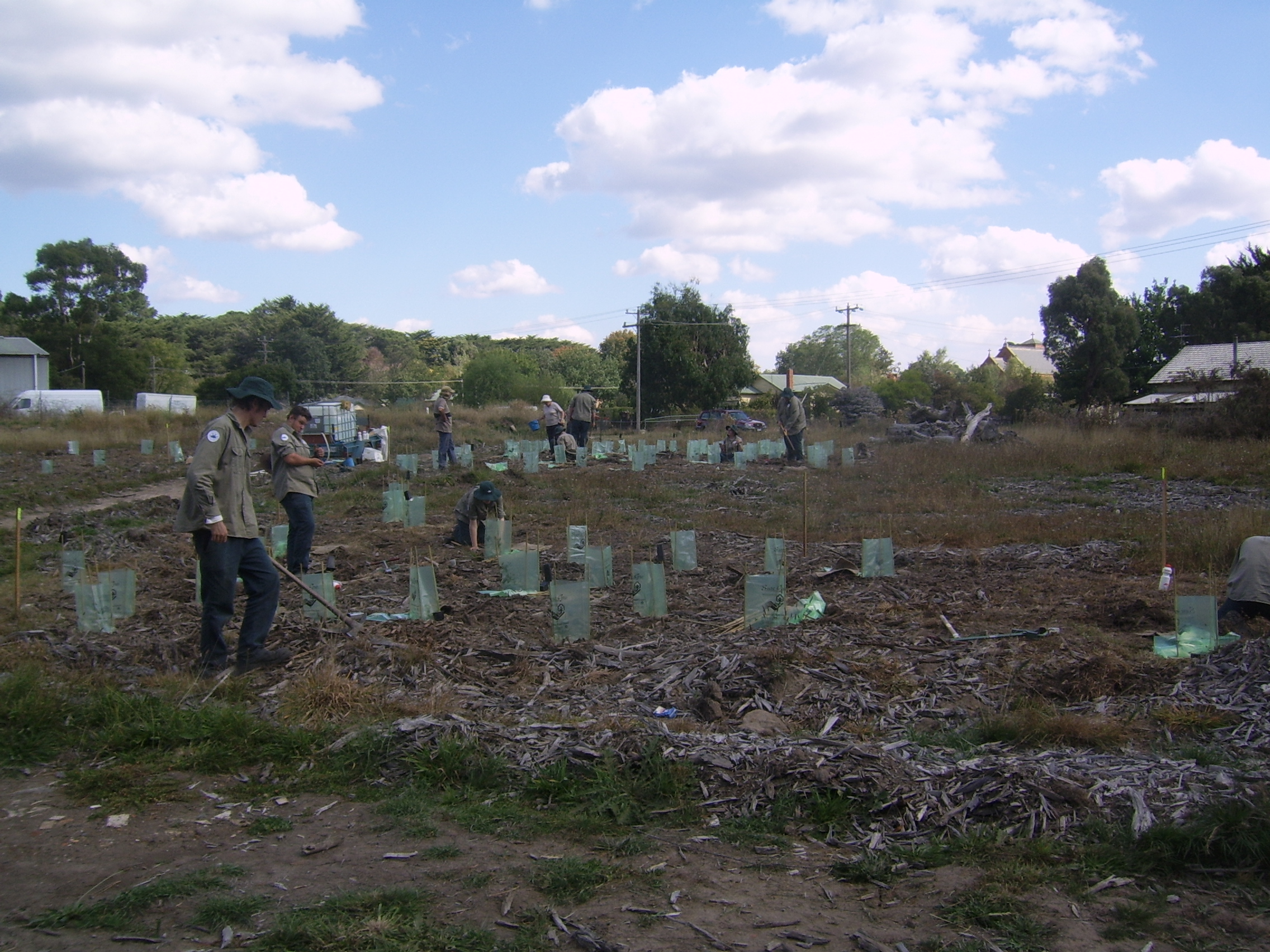
Woodend Green Corps team planting into poplar mulch at the EnviroFund site with Landcare volunteers in 2007
Stage 3 in 2006-7 was very challenging as it involved clearing dense infestations of weedy poplars on the south bank of the creek between Pyke Street and Bowen Street. In the left image below, taken in 2007 by esteemed local photographer Bruce Hedge, shows the western part of the area between Pyke Street and Wood Street after the poplars were removed. You can see white jute weed matting laid out for the first plantings. The second image (right) shows the same site 19 years later.
After the poplar removal, we encountered an unexpected problem when we discovered that our forebears had used the pictured area as a landfill site. So before we could start planting, this area had to be examined and capped.
The CFA asked us not to replace the poplar forest with a native forest, so we did “island plantings” making it more fire-safe, with mowable grass areas in the gaps. In 2010 we also planted the area with 25 non-weedy and fire-safe exotic trees in the mowed area.
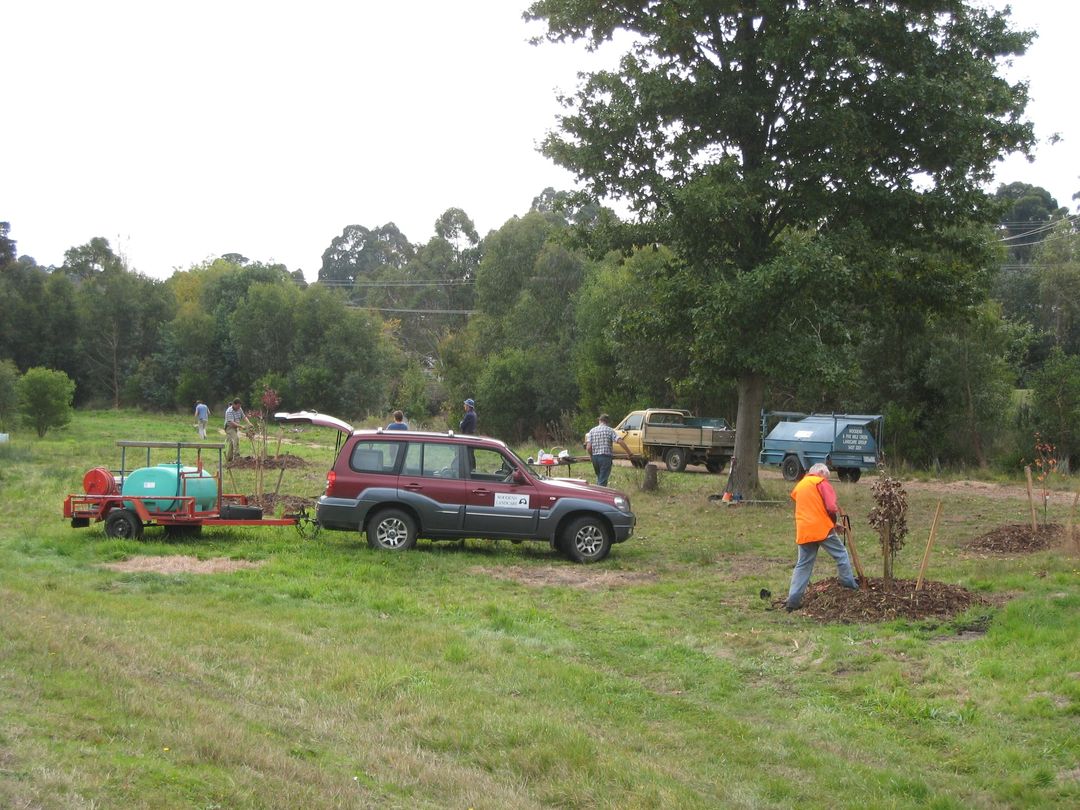
“The paddocks” planting day in 2011
The plan also entailed making a path along the south side of the creek from Pyke Street to Bowen Street, with an access path to Wood Street. We had the foresight to leave a gap in the plantings to allow for a potential future pedestrian bridge over the creek just west of Bowen Street. Thanks to a bequest from Jo Clancy, that bridge became a reality 16 years later, and was opened in 2023.
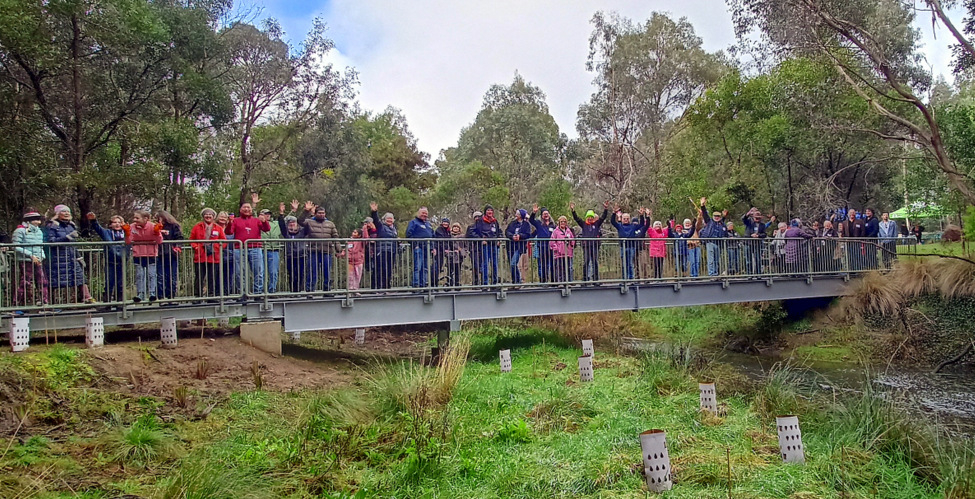
Opening of Jo’s Bridge in 2023
Between 2023 and 2024 more indigenous seedlings were planted in the revegetation areas of the Envirofund Paddocks as part of the widespread Pollinator Corridors project.
Pollinator corridor planting 2024
In the future, more local shrub and ground cover species will be planted throughout the area to fill in the understorey gaps, providing more habitat for wildlife and increasing the biodiversity.
We do hope to find a more imaginative name for the paddocks between Bowen and Pyke Streets, but for now, we continue to call the area the “Envirofund Paddocks”.
Upcoming Woodend Landcare working bees (see calendar):
Thursday Crew each Thursday morning, weather permitting – Various locations around Woodend. Contact Dave Bower at dvbower65@icloud.com
Next Sunday working bee will be on 20th September, based at Ruby Mackenzie Park at the end of Anne Road commencing with a briefing at 8.45am. Join us doing woody weed control, with a great morning tea provided.