Our next working bee is on Sunday 23 March from 9 am to 12 pm. We will focus on removing woody weeds and ivy along Five Mile Creek from Thomas to Samuel Court. Park at Thomas Court and meet nearby in the Five Mile Creek reserve. Hope to see you there!

Removing English Ivy in Woodend
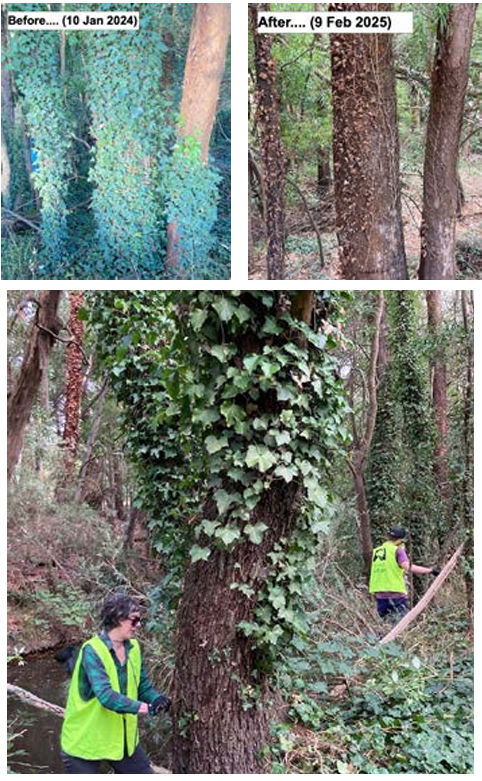
Thirteen adults and three children gathered at our Working Bee near the Rotary Exercise Track on 9 February. They aimed to remove the noxious English Ivy invading the native vegetation. Ivy removal in native vegetation has been a big focus for Woodend Landcare for years.
“Four years ago, when we started working here, English Ivy covered the entire ground. It was smothering any native seedlings that tried to grow.” Peter Yates explained, “The ivy was climbing nearly every tree trunk throughout the area. In some cases, it was smothering the entire trees.”
English Ivy (Hedera helix) loves the cool, wet, English-like conditions of the Macedon Ranges. It survives by creeping along the ground until it finds something to grow up, like a tree. It then climbs up the tree, completely covering it. Only once off the ground, the ivy will flower and seed. At height, this is the perfect location for birds to feed on the seed. The birds then spread the seed in their droppings, as they fly around. Bird droppings are crucial for the start of ivy’s life. They provide nutrients and moisture and offer a free flight to new locations.
By knowing the life cycle of ivy, we can target our eradication efforts to be most effective. By stopping it from climbing trees, we stop it from flowering and producing seeds. For trees that are heavily infested with ivy, we cut the ivy from the bottom 30 cm of the trunk. We also scrape the ivy from a 30 cm ring on the ground around the trunk. Eventually, the ivy will creep back towards the trunk and will start to climb up again. This process gives us a year or two to spray or hand weed the ground layer to stop its spread.
You can easily replicate this method at home. Simply prevent the ivy from climbing up any vertical structures including trees and fences. By doing this, you will stop it from flowering and setting seed. You don’t have to remove ivy from the whole trunk of heavily invaded trees. Simply cut the ivy at the base of the tree and every shoot and leaf above that will die. Over time, the dead ivy leaves will simply fall from the trees. This method does not kill the ivy on the ground. Nevertheless, it stops the ivy from being spread by birds into other gardens and the natural environment.
 Woodend Landcare