Happy 2026 to all of our Woodend Landcare volunteers and supporters.
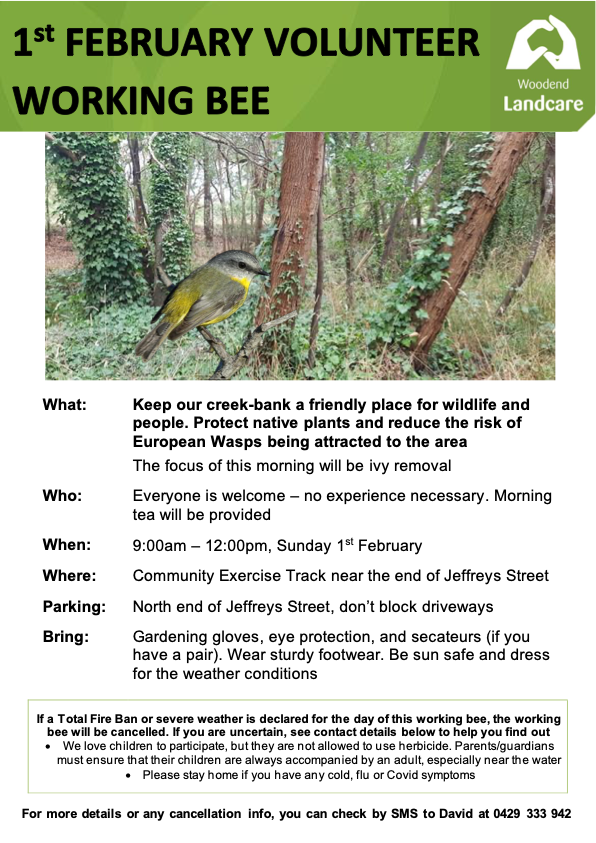
Our first Working bee for the year is this Sunday (1 February 2026). It will be held along the community exercise track at the end of Jeffreys Street. We hope to see many of you there!
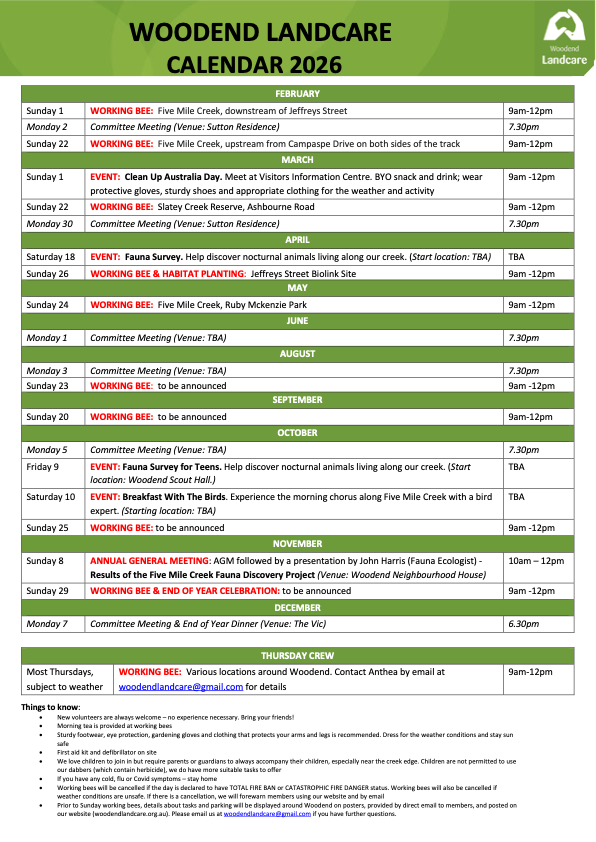
We have a exciting year of events planned for 2026. Here is our 2026 calendar to take note of all our dates…
Join us this Sunday morning to continue removing weeds from the southern bank of Five Mile Creek. This month we’ll continue heading towards the Children’s Park from Wood Street, which is where we got to last month. Meet up 9am, near the creek end of Wood St, Woodend. See flyer for details.
Woodend Landcare is pleased to support the Macedon Ranges Youth Climate Group with their first youth-led planting day. The group choose Five Mile Creek for their project as it is the home to the endangered and rare Black Gum species. They aim to help Black Gum with a restoration project to enhance and protect its habitat.
The Youth Climate Group have the goal of planting 350 native plants. They have selected species that align with the local area and the Five Mile Creek Master Plan, including:
Lomandra longifolia
Poa lab
Leptospermum obovatum
Themeda triandra
Acacia melanoxylon
Carex appressa
Black gum
This project is about more than just trees – it’s about empowering young people to take meaningful climate action, connecting with like-minded groups, and leaving a positive legacy for future generations.
When: 11am, Saturday 4 October 2025
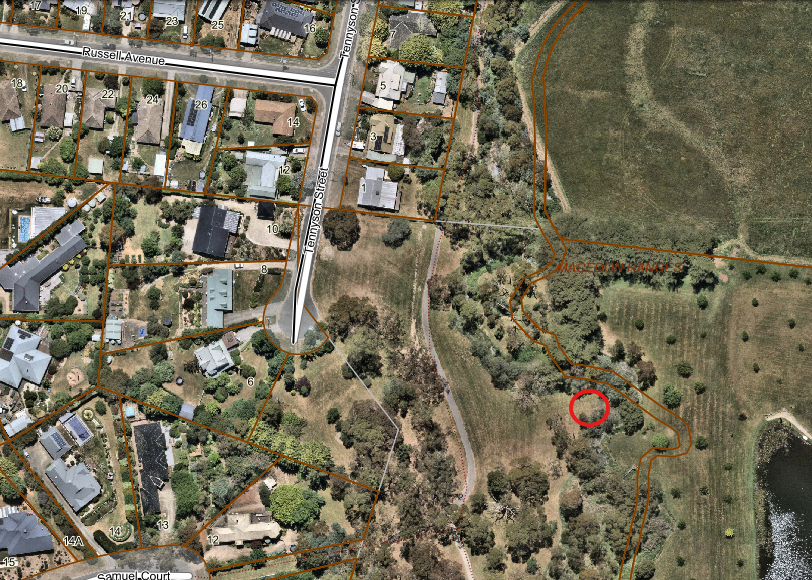
Where: Woodend Five Mile Creek near Tennyson Street. Enter via the park at the end of Tennyson Street. Then, head over to the creek on the other side of the walking path.
Look out for our resident Wallabies and Kangaroos!
Woodend Landcare has recently noticed increased numbers of wallabies and kangaroos in town. Kangaroos have always come and go from Woodend Grassland Reserve. Recently, they have been spotted along the train line close to the CFA. They are have also been seen in the Quarry Road Retarding Basin and along the reek near Ruby Mackenzie Park. Wallabies are typically a little more unusual to spot along the creek. Recently, they have been sighted near Jeffreys St and the Grassland Reserve. They have also been seen between Shirley Park bridge and Jo’s Bridge and in adjoining properties.
Woodend Landcare is not sure what is driving this increase in numbers. It may be a lack of food. It could also be a reduction in habitat around town. Regardless, we are concerned for their well-being in these more urban areas.
Landcare has contacted Macedon Ranges Shire Council. We will be installing temporary “Please keep your dogs on leash” signs until something more permanent can be arranged. Hopefully, these signs help educate everyone that the wallabies have moved in and keep our furry friends safe.
The importance of plant guards
There are many reasons why plant guards are used when planting seedlings. Their primary role is to protect the tiny plants from:
Grazing by rabbits, kangaroos, and wallabies
Wind and harmful weather
Trampling by people and dogs
Destruction by mowers and whipper snippers
Smothering and competition for resources by surrounding weeds (with a weed mat)
However, there are also many less obvious reasons for using plant guards, including:
Making a visual statement of where revegetation activities have taken place.
Enabling easy identification of small natives from surrounding weedy vegetation, this is particularly important for native grass-like seedlings and bulbs that die back for part of the year.
Cordoning off areas from mowing to enable natural regrowth within revegetation sites.
Enabling data collection to monitor seedling survival rates, so planting success can be improved (even guards around dead seedlings give us important information!).
Easily identify seedlings for follow up watering and weed control.
Why don’t we guard every plant?
Plant guards are expensive and installation takes time, so we don’t guard plants unless we think they are really necessary.
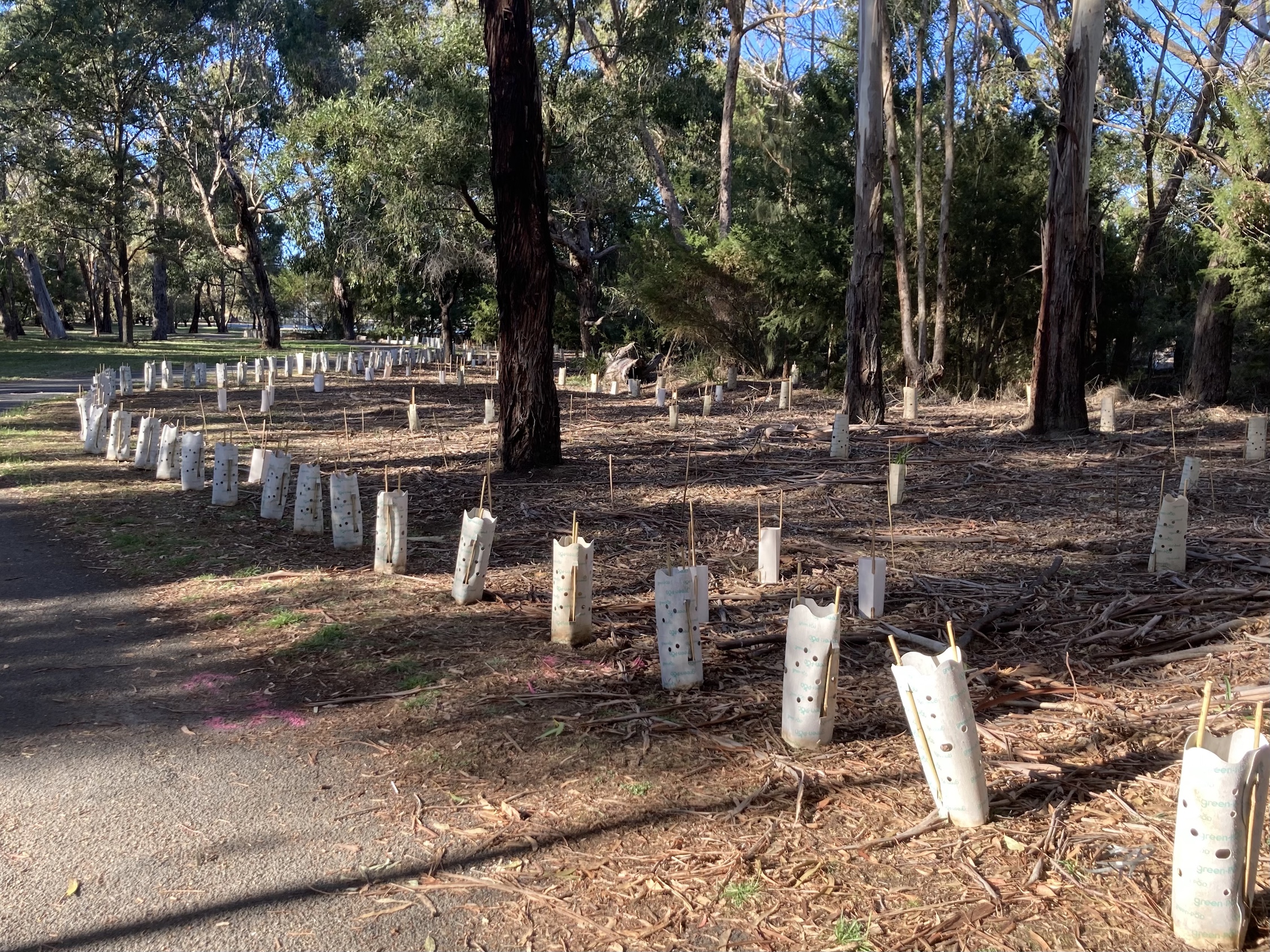
Every planting site is different. In our recent Black Gum Biolink plantings, we mainly guarded plants bordering the path between Jeffreys Street and the Scout Hall. This was done to form a ‘fence’. The majority of the plants inside the revegetation area are simply marked with a bamboo stake. The mulch will prevent them from being smothered by weeds.
What sort of guards do we use?
There are many different plant guards available. Traditionally we mainly used plastic sleeves held in place by bamboo stakes. However, the use of plastic is no longer desirable. We now only reuse plastic plant guards in places where they are unlikely to wash or blow into a waterway.
Woodend Landcare now uses bio-degradable cardboard guards which breakdown if they end up in the creek. Cardboard guards come in various sizes. The larger guards have holes in the sides and the top to allow light in. The size of the guard used is matched to the plant and the conditions.
Please, do not remove plant guards!
Woodend Landcare has spent a lot of time and money buying and installing plant guards. Recently guards have been disappearing before the seedlings are big enough to survive without them.
We strongly request that nobody removes plant guards for the reasons outlined above. Woodend Landcare volunteers will take away the guards when the time is right.
If anyone wishes to learn more about revegetation, please contact us at woodendlandcare@gmail.com. Everyone is welcome to join our volunteers to remove plant guards in due time.
Next Working Bee
Our next Sunday working bee is on 14 September from 9am until midday. We will be undertaking weed control along Five Mile Creek, between Bowen and Wood Sts. More info coming soon!
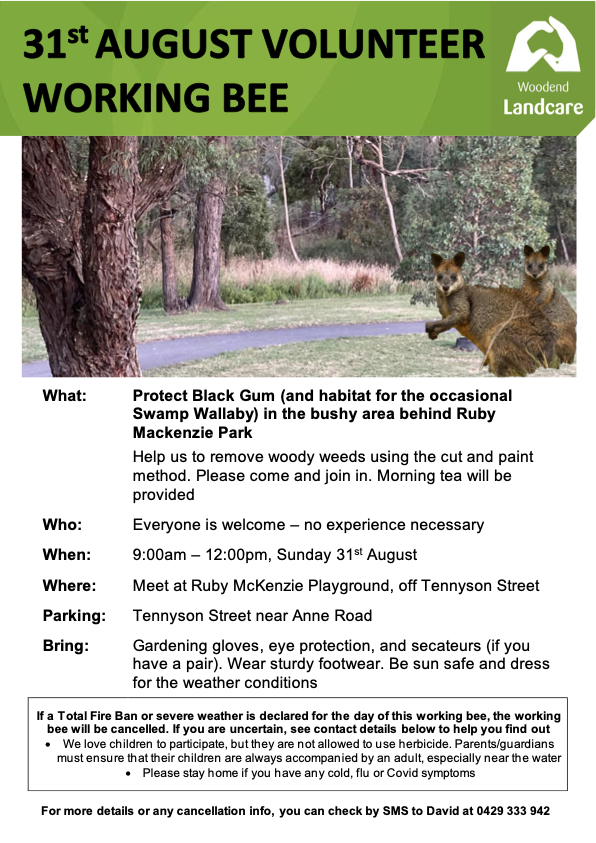
Join Woodend Landcare volunteers 9am-noon, Sunday 31 August at Ruby Mac Park for a morning looking after the indigenous habitat along Five Mile Creek. See flyer for details.





 Woodend Landcare