Living in the Macedon Ranges, we are fortunate to have many native birds. These birds call the natural environment, our farms, and gardens “home”. Our native birds have to deal with various threats to their existence, like roaming cats and foxes. Perhaps the biggest threat comes from the sky in the form of Indian Mynas (also known as “Common Mynas” or “Rats of the Sky”). These birds were introduced in 1862 from Southern Asia to control insects in Melbourne’s market gardens. That idea didn’t work, but the birds spread across Australia.
Indian Mynas are medium sized birds, with a brown body, black head, and yellow feet and beak. They are aggressive birds that predate on native birds and small animals, actively taking over nesting hollows. In some places, they have effectively eradicated all native bird life. Conversely in some places, trapping programs have virtually eliminated the Indian Myna birds.
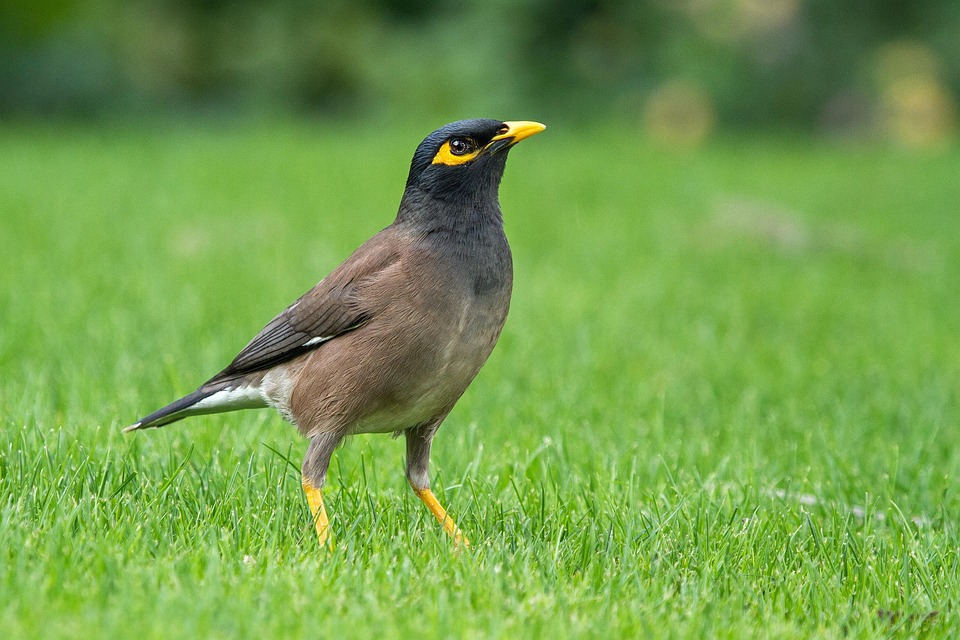
Indian Mynas are scavengers and will thrive in places where food scraps are available. Left over pet food, chicken food or lunch scraps are all attractive to them. With a little effort, it is possible to reduce these food sources.
Across Australia, some Landcare groups and local councils have initiated successful control programs. The Indian Myna eradication program in the Macedon Ranges started in 2013. It was initiated and continues to be organised by Ron Fink, a member of Woodend Landcare. There are trappers and coordinators in most Macedon Ranges towns, resulting in some areas being almost free of Indian Mynas. Still, there is an ongoing need for volunteers. At present Kyneton has no trappers or a town coordinator, so unfortunately the Myna population is set to grow again.
If you do see or hear Indian Mynas on your property, consider becoming a trapper. It is a very worthwhile and beneficial contribution to the biodiversity in your area. Traps are available for free on a loan basis and training is provided. Traps are basically one-way walk-in cages. Trapped birds are kept in comfortable conditions and humanely euthenased as soon as possible after trapping.
If you think you can help MRIMAG (Macedon Ranges Indian Myna Action Group), please contact Ron Fink on 0407 661 129 or via email at woodendlandcare@gmail.com.
Click here for further information.
Upcoming Woodend Landcare Working bees (9am Sundays):
Thanks to everyone who attended our Working Bee on the 22 February 2026. Here are our up coming events:
- 1 March – Clean Up Australia Event. Meet at Woodend Information Centre. BYO snacks and drink, gloves, appropriate clothing/shoes and be sun smart.
- 22 March – Slatey Creek Black Gum Reserve, Ashbourne Rd.
- Thursday Crew 9am every Thursday at various sites when weather permits.
 Woodend Landcare