Planting Day- Sunday 25 May 2025

We hope to have many hands helping at our Planting Day on Sunday 25 May 2025. There are around 800 grasses to plant in the revegetation sites along Five Mile Creek. The sites are located between the northern end of Jeffreys Street and the Heritage Walk near the tennis club. Importantly, our efforts will help protect the existing Black gum trees and create habitat for local birds and animals. Arrive at 9 am with your gloves and eye protection. Morning tea and planting tools are provided. Park at the tennis courts. Hope to see you there!

Local Landcare News and Events

Newham Landcare’s Autumn 2025 newsletter. Wildlife is a major feature following a recent evening with ecologist Tanya Loos, plus articles by guest writers David Cheal on Blackwoods, Stephen Murphy on Wombats and Olivia Hedge on Electrify 3442, plus other news and regular features. Click here to view.

Healthy Land, Healthy Horse – Equine Landcare information session. Macedon Ranges Shire Council is hosting a session in Macedon on the 30 May 2025. Click here to find out more.

Hepburn Gardens for Wildlife – Native Plants Screening Workshop – 10 May 2025

27 April Working Bee and more…

Working Bee – 9am, 27 April 2025, Ruby Mackenzie Park

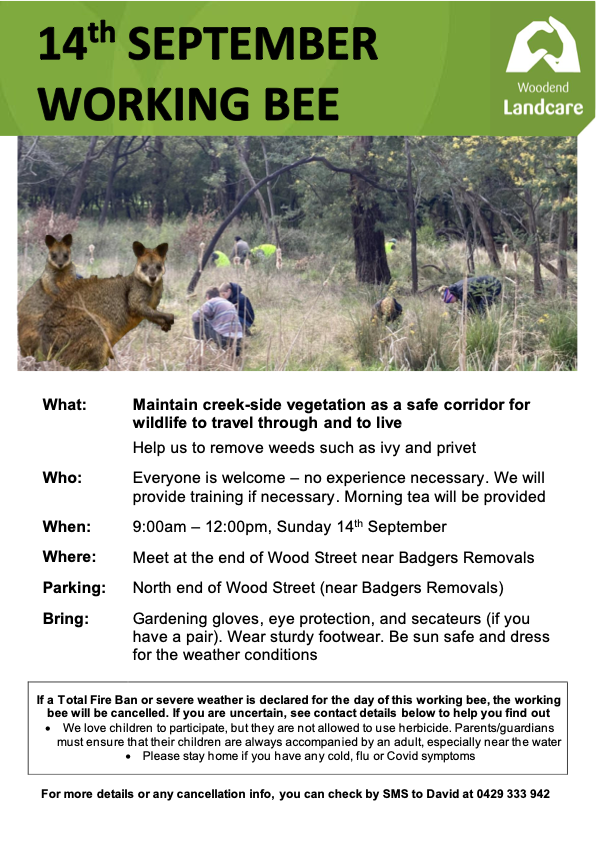
This month we return to the bushy area behind Ruby Mackenzie Park. We will undertake important woody weed control using the cut and paint method. Our efforts will help the Black Gum and the occasional Swamp Wallaby visitor. Please join us at 9am Sunday 27 April 2025.

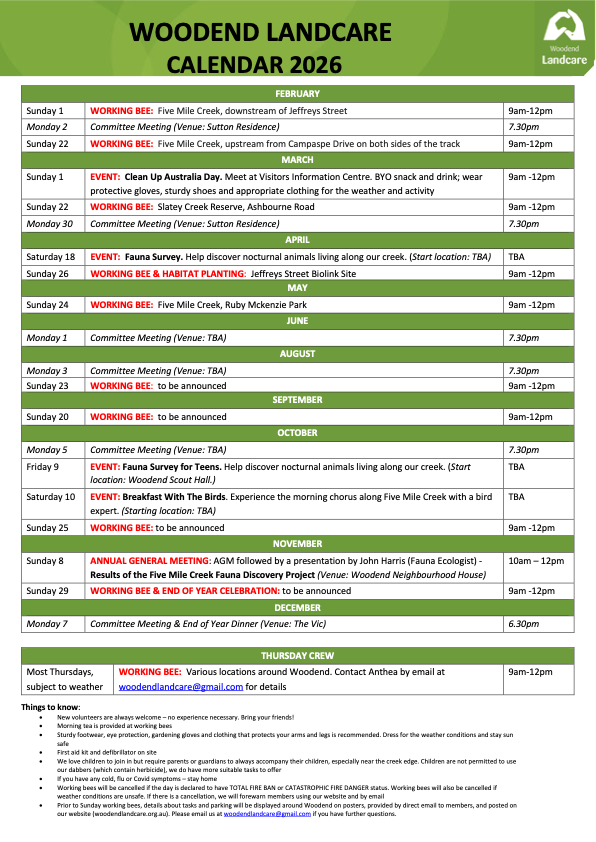
Calendar Update

The committee recently updated Woodend Landcare’s calendar of activities. Please be sure to mark these dates and locations in your diary…

Biolink Planting Thanks

Some images and a note of thanks to those who attended out planting day on the 6 April 2025 from Woodend Landcare President, Peter Yates:

Thank you for your help with our Biolink Planting. Congrats on all your work and hopefully we will be rewarded with some decent rain soon.

It brought home to me what a great band of people we have, each helping in their own particular ways. We have a wide range of expertise and experience to draw on and we don’t always agree on the way to do things, but we always manage to tie it all together and produce a great result.

I won’t mention names, but I want to thank everyone, including those that did the planning, managed the funding, the sorting of plants, the publicity, the manual work on the site, the watering, the catering crew and of course my chauffer!

I think this was the trickiest planting we have done for a long time. We tried to plant a much wider range of species over a much more scattered range of sites, each with it’s own planting layout, and at the end of an incredibly dry period. The soil in some areas was so hard and dry that without the two augers and a steady supply of batteries, we probably wouldn’t have got there. 

We have some things to learn in terms of the timing and nature of future plantings. But that is the case with all our projects.

Thanks again to everyone for a big effort.

Peter  

Working Bee – 6 April 2025

We have 360 seedlings to plant at our next working bee on Sunday 6 April 2025. In the reserve behind the Woodend Tennis Club, we will be looking to protect the rare Black Gums of Woodend. In time, the plants will create important habitat for local birds and animals. We would love to have many hands to help with the planting day. Morning tea is provided!

Working Bee – 23 March 2025

Our next working bee is on Sunday 23 March from 9 am to 12 pm. We will focus on removing woody weeds and ivy along Five Mile Creek from Thomas to Samuel Court. Park at Thomas Court and meet nearby in the Five Mile Creek reserve. Hope to see you there!

Removing English Ivy in Woodend

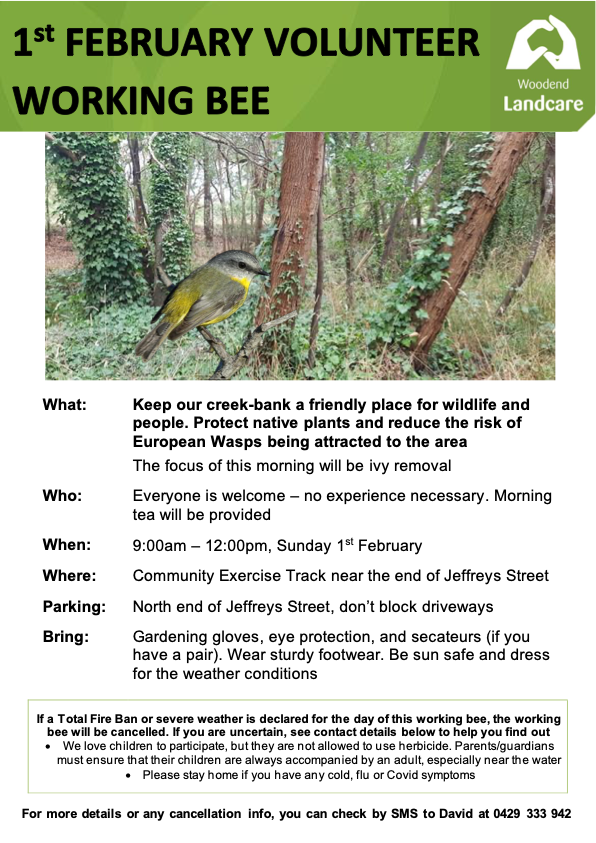
Thirteen adults and three children gathered at our Working Bee near the Rotary Exercise Track on 9 February. They aimed to remove the noxious English Ivy invading the native vegetation. Ivy removal in native vegetation has been a big focus for Woodend Landcare for years.

“Four years ago, when we started working here, English Ivy covered the entire ground. It was smothering any native seedlings that tried to grow.” Peter Yates explained, “The ivy was climbing nearly every tree trunk throughout the area. In some cases, it was smothering the entire trees.”

English Ivy (Hedera helix) loves the cool, wet, English-like conditions of the Macedon Ranges. It survives by creeping along the ground until it finds something to grow up, like a tree. It then climbs up the tree, completely covering it. Only once off the ground, the ivy will flower and seed. At height, this is the perfect location for birds to feed on the seed. The birds then spread the seed in their droppings, as they fly around. Bird droppings are crucial for the start of ivy’s life. They provide nutrients and moisture and offer a free flight to new locations.

By knowing the life cycle of ivy, we can target our eradication efforts to be most effective. By stopping it from climbing trees, we stop it from flowering and producing seeds. For trees that are heavily infested with ivy, we cut the ivy from the bottom 30 cm of the trunk. We also scrape the ivy from a 30 cm ring on the ground around the trunk. Eventually, the ivy will creep back towards the trunk and will start to climb up again. This process gives us a year or two to spray or hand weed the ground layer to stop its spread.

You can easily replicate this method at home. Simply prevent the ivy from climbing up any vertical structures including trees and fences. By doing this, you will stop it from flowering and setting seed. You don’t have to remove ivy from the whole trunk of heavily invaded trees. Simply cut the ivy at the base of the tree and every shoot and leaf above that will die. Over time, the dead ivy leaves will simply fall from the trees. This method does not kill the ivy on the ground. Nevertheless, it stops the ivy from being spread by birds into other gardens and the natural environment.